

Trust in Transition #27
The Edelman Trust Barometer and the Politics of Doublethink

Welcome to the May 2026 edition of Trust in Transition. Trust in Transition is a monthly Substack published by the Trust Project at WiSER, bringing together research on finance, technology, and trust in Africa as it unfolds.
Inside This Edition
📆 The WiSER Desk
🌍 WiSER on the Move
⭐ The WiSER Feature: “The Edelman Trust Barometer and the Politics of Doublethink” by Keith Breckenridge
✏️ Contributions:
In this edition, WiSER Trust scholars and affiliates engage with the following:
“Digital Identity a la South African Home Affairs – Revealing Digital Identity Regulations Published for Comment.” Jonathan Klaaren | Professor | Law & Society
“Zero Trust Approach to Bolster South Korea’s Cybersecurity Strength.” Hannah Krienke | Doctoral Fellow | Trust
“When Trust Turns Against the Migrant.” Fatima Moolla | Postdoctoral Fellow | Trust
“Ghana’s Biggest Mobile Money Service Provider is Finally a Standalone FinTech.” Caroline King | Doctoral Fellow | Trust
This month’s edition examines how trust becomes a tool of governance, contestation, and control across public life. The contributions move from the politics of the Edelman Trust Barometer to South Africa’s emerging digital identity regulations, anti-immigrant mobilisation, Ghana’s mobile money sector, and South Korea’s Zero Trust cybersecurity model. Across these pieces, trust appears as something institutions measure, claim, enforce, and sometimes weaponise. The edition asks what happens when trust becomes a language for managing crisis, securing systems, organising belonging, and shifting responsibility onto those with the least power.
📆 The WiSER Desk
The Trust Seminar
In May, two trust seminars took place. Keren Weitzberg presented her work, The Mau Mau Passbook: from Fingerprint of Empire
As part of the Emergency measures in the 1950s, the British colonial government in Kenya introduced regulations that imposed passbooks on the Kikuyu, Embu, and Meru (KEM), who were seen as the wellspring of Mau Mau. Implemented in 1954, the passbook system, which bore resemblance to the formally abolished kipande, restricted the freedom of movement of a population seen as collectively suspect. Like the vipande, passbooks were aimed at controlling the movements of Africans outside their designated native reserves and regulating their ability to work. But the new system, which applied exclusively to those ethnic groups deemed a security threat, further securitized this bottleneck. Passbooks were part of a broader counterinsurgency strategy aimed at screening “unidentifiable” urban residents, sieving the “loyal” from the “disloyal,” restricting the mobility of inhabitants of Central Province, and isolating insurgents and their sympathizers from rights to the city. As I explain in this chapter, passbooks also became a vehicle for an ambitious, if short-lived, attempt at racialized social engineering—aimed at remaking Nairobi’s residents into a “respectable” urban working class based on notions of stable, companionate marriage.
Gregory Gondwe presented his paper titled, AI-Driven Disinformation and Political Influence on WhatsApp in South Africa’s 2024 Elections
This study investigates the role of encrypted messaging apps, specifically WhatsApp, in disseminating political disinformation during South Africa’s 2024 general elections. Drawing on a dataset of 22,384 messages from 47 politically active WhatsApp groups and 6,283 unique users, the study identifies how AI-generated deepfakes, emotional manipulation, and ideological group structures facilitated the spread of false political narratives. Using MyFactChecker, an AI-powered sentiment and verification tool, we reveal that disinformation most frequently relied on fear-based appeals (41%), identity-driven rhetoric (32%), and content mimicking credible journalism (27%). The findings show that disinformation gained traction not through factual accuracy but through emotional resonance and relational trust within ideologically cohesive groups. Even when flagged as false, corrective content was often dismissed as propaganda or foreign interference, thus underscoring how truth contests unfold within closed, affective networks.
The next seminar, Between crisis and refusal: academic freedom as public argument, will be presented by Nimi Hoffmann on Monday the 25th of May.
WiSER's TRUST seminar is hosted online every Monday afternoon at 16:00 - 17:00 SAST during the teaching semester.
WiSER on the Move🌍


Doctoral fellow Caroline King attended the Point Sud Conference “Green and Digital Futures. Rethinking the Twin Transition in Africa in an Era of Multiple Crises” at Makerere University in Kampala, Uganda, from 18 to 22 May 2026. She presented her work on Digital Financial Services and State Infrastructures in Ghana, thinking beyond the digital and asking questions around how the green transition can be situated within the digital financial sector in Ghana.


Postdoctoral fellow Fatima Moolla attended the SA-UK Bilateral Chair in Political Theory Public Lecture Series, hosted by Professor Lawrence Hamilton, featuring a lecture by Dr Singumbe Muyeba (University of Denver) where he presented his book titled “The Homeowner Ideology: Why Support for Homeownership Persists Despite its Failure to End Income Poverty.”


Fatima also attended the seminar, “Re-reading Camões: Ocean Worlds, Contact and the Indian Ocean from Southern Africa,” hosted by the Embassy of Portugal, Camões – Instituto da Cooperação e da Língua, and the University of the Witwatersrand. The seminar featured WiSER’s Isabel Hofmeyr in conversation with Lucy Graham from the University of Johannesburg and the Portuguese Ambassador, offering a contemporary re-reading of The Lusiads through Indian Ocean perspectives, with attention to mobility, maritime routes, and early encounters in Southern Africa.
The WiSER Feature 📝
The Edelman Trust Barometer and the Politics of Doublethink
Keith Breckenridge | Standard Bank Chair in African Trust Infrastructures
“Winston sank his arms to his sides and slowly refilled his lungs with air. His mind slid away into the labyrinthine world of doublethink. To know and not to know, to be conscious of complete truthfulness while telling carefully-constructed lies, to hold simultaneously two opinions which cancelled out, knowing them to be contradictory and believing in both of them; to use logic against logic, to repudiate morality while laying claim to it …” George Orwell 1984, p. 37.
When the Wall Street Journal commented, last week, on the impressive popular disapproval of the current leaders of Germany, France and Britain, they diagnosed the common problem as a “crisis of trust.” This characterisation seems strange given the intractability of the crises that European countries now face: maintaining generous pension and health provisions in the face of demographic decline, the cultural difficulties that are triggered by the large scale migration that may address those problems, the collapse of long-dominant industries in the face of two Chinese export shocks, energy shortages triggered by the Ukraine and Gulf wars, sharp-edged constraints on public borrowing, the ragged condition of large public infrastructures and fears of an AI-dominated future and unmanageable climate change. Voters are surely right to be pessimistic about the solutions that experts and politicians are offering, not because they are untrustworthy, but because they are extremely difficult, and may be unachievable. A similar point can surely be made about the over-use of the idea of the collapse of trust in the election of Donald Trump. The splintering of the European electorate into four or five roughly similarly sized groups reflects an awareness that the changes that are required in the immediate future will have costs that are not shared equally across these societies. Blaming all of this on the decline of trust is, at best, confusing. It is also very common.
What has prompted this obsessive reliance on the decline of trust as the single explanation of the political crises that democratic societies have faced since the late 1990s? Here the answer is refreshingly obvious. For a quarter of a century, Edelman — the largest public relations company in the world — has published the results of an annual survey of confidence at the Davos meeting of the World Economic Forum. Each year they claim that the results show that trust in the state, in civil society, in the economy and in expertise is collapsing. The results have been absorbed and publicised, especially since the early 2010s, by the most influential media outlets — the Financial Times, the Wall Street Journal, the New York Times, the BBC, CNBC, and even the SABC. The radically simplified scores generated by the Edelman surveys, compared across countries, industries, institutions and social classes, have proven to be catnip for journalists looking for a tool to summarise change and its effects on popular sentiment.
Less obvious in the journalists’ accounts, is the enormously successful commercial project behind the Edelman survey, which was designed to sell consulting services to the world’s largest firms and richest governments (and, less successfully, the largest NGOs). As Lee Edwards, one of a small group of researchers working on this problem, explains it, the survey: “confirms a world in stasis, where the trust crisis persists, society is unstable, the economic and political status quo is fragile and where business may re-establish trust by listening to its employees and other stakeholders, and stepping into the leadership vacuum.” (Edwards 2024) Edelman promises to make this risky step into the public domain more manageable for corporations by providing a suite of trust products – the Edelman Trust Institute, the Trust Broker, the Net Trust Score, and the Trust Stream to “monitor the state of their trust capital across countries and audiences.” The message of the Barometer, is “transparently self-serving,” as Alison Taylor, of NYU’s School of Business, puts it: “The message is always that it is up to CEOs to act as a panacea for declining trust in other institutions.” (Taylor 2026) While it might temper some of the claims about trust if the journalists writing about the results of the survey recognised that it is also a sales pitch, it is hardly surprising. That the largest public relations firm in the world looks to leverage research on social problems to sell advisory services and favourable content to the largest international corporations is hardly news: that, after all, has been the main object of public relations since the 1950s. (Aronczyk 2026)
The political effects of the Edelman barometer are less obvious, and they lie in three related core functions of the survey project. The first is in the radical simplification of the understanding of trust itself, which has become, under the global influence of the Edelman project, a nationally-defined percentage applied to broad categories (business, government, media, NGOs). This simple scoring is in impressive contrast with the scholarship on trust, which after 2008 stressed the importance of democratic scepticism for good government, and of credit, of fiduciaries, of the law of equity, of offshore finance and colonial trusteeship in the workings of trust. (Cook et al. 2009; Capps 2010; Harrington 2016) The second source of political difficulty derives from Edelman’s continuous injunction that businesses, and their CEOs in particular, must “lead to solve problems.” In the aftermath of Brexit and the first Trump election — the advice had become “Business on the Brink of Distrust … Must Act.” By the 2019 report, Edelman was insisting that “CEOs must speak up directly on social issues, such as immigration, diversity and inclusion.” The following year the Barometer used the results to the question: “How important is it to you that the CEO or head of the organization you work for speaks out publicly about each of the following issues?” to argue that 73% of employees wanted their bosses to speak publicly on climate change.(Edelman 2017, 2019, 2020) While, on the face of it, the injunction for large firms to take positions on some of the compelling problems of injustice in the United States seems reasonable, the likely polarisation effects were, as Taylor notes, already obvious.(Taylor 2026) The real politics of the Edelman recommendation for business to “step up to fill the trust vacuum” emerges from the third function of their work.
Arguably from before the first survey in 2001, the company has specialised in the development of social media campaigns designed to create the impression of popular opposition to government regulations and restrictions — first coming to public notice for an email writing campaign against the US Department of Justice antitrust suit against Microsoft in 1998. (Miller and Helm 1998) They have since pursued what we would now call social media and influence campaigns for the most important oil and gas companies, their lobbying organisations, and, recently, the energy powers of the Gulf states. The company insists that it does not work with firms that deny the scientific reality of climate and by supporting energy companies and states it is helping to build “the big tent” that is required to address the crisis. (Goldenberg and correspondent 2015; Gunther 2015; Edelman 2021; A. Lowenstein 2022; A. M. Lowenstein 2024) Yet these collaborations have included carefully worked out online campaigns to delegitimise individual online critics, and to encourage and monitor the internet engagement of company employees and other allies of the energy companies.(Austen 2014; Taggart 2021; Volcovici 2022; Mufson 2022; A. M. Lowenstein 2024) In their 2021 study of the public relations firms that undertake contracts for energy companies and related NGOs, Brulle and Werthman show that of the twenty largest companies, Edelman has been the most important and the only firm documented to undertake all of the seven dominant campaign strategies : these included Third Party Mobilization, Delegitimization of Opposition, Grassroots rallies / events and Social Media Campaigns. (Brulle and Werthman 2021)
What does all of this mean for the study of trust? First, the Edelman Barometer obscures much of the complex and rich academic work on trust — especially the studies of credit, of fiduciaries and the politics of colonial trusteeship. Second, while Edelman insists that they are providing a full and fair airing of their clients’ interests, their focus on the decline in trust in the media, in government and in institutions, while working to undermine key critics and policies, means that they are effectively turning trust against itself. A similar point can surely be made about encouraging business to articulate positions on the most divisive social and economic problems. Third, and perhaps the key takeaway here, is that trust cannot do all the work the company is claiming for it, at least not within the discursive model they advocate — both for large companies and societies. Conflating the political complexity and difficulties of global change after 2001 with “declining trust”, to be addressed by businesses speaking out — as the company has relentlessly done since 2001 — obscures the real causes of discontent, and positions trust itself as a facade obscuring very serious problems.
References:
Aronczyk, Melissa. 2026. “How PR Firms Captured the Sustainability Agenda.” Foreign Policy, May 27. https://foreignpolicy.com/2022/02/17/climate-crisis-activism-edelman-pr-sustainability.
Austen, Ian. 2014. “P.R. Firm Urges TransCanada to Target Opponents of Its Energy East Pipeline.” Business. The New York Times, November 18. https://www.nytimes.com/2014/11/18/business/pr-firm-urges-transcanada-to-target-opponents-of-its-energy-east-pipeline.html.
Brulle, Robert J., and Carter Werthman. 2021. “The Role of Public Relations Firms in Climate Change Politics.” Climatic Change 169 (1): 8. https://doi.org/10.1007/s10584-021-03244-4.
Capps, Gavin James. 2010. “Tribal-Landed Property: The Political Economy of the BaFokeng Chieftancy, South Africa, 1837-1994.” London School of Economics and Political Science (University of London). http://ethos.bl.uk/OrderDetails.do?uin=uk.bl.ethos.528664.
Cook, Karen S., Margaret Levi, and Russell Hardin, eds. 2009. Whom Can We Trust? How Groups, Networks, and Institutions Make Trust Possible. A Volume in the Russell Sage Foundation Series on Trust. Russell Sage Foundation.
Edelman. 2017. Trust Barometer Global Report. https://www.edelman.com/sites/g/files/aatuss191/files/2025-01/2017%20Trust%20Barometer%20Global%20Report_FINAL.pdf.
Edelman. 2019. Trust Barometer : Executive Summary. https://www.edelman.com/sites/g/files/aatuss191/files/2019-02/2019_Edelman_Trust_Barometer_Executive_Summary.pdf.
Edelman. 2020. Trust Barometer Global Report. https://www.edelman.com/sites/g/files/aatuss191/files/2020-01/2020%20Edelman%20Trust%20Barometer%20Global%20Report_LIVE.pdf.
Edelman (Edelman). 2021. “Climate Change: Our Way Forward.” November 15. https://www.edelman.com/newsroom/richard-edelmans-6am-blog/climate-change%3A-our-way-forward.
Edwards, Lee. 2024. “Trust, Truth and ‘Organized Lying’: A Critical Study of the Edelman Trust Barometer.” In Routledge Handbook of the Influence Industry, edited by Emma L. Briant and Vian Bakir. Routledge.
Goldenberg, Suzanne, and US environment correspondent. 2015. “World’s Biggest PR Firm Calls It Quits with American Oil Lobby – Reports.” Business. The Guardian, February 19. https://www.theguardian.com/business/2015/feb/19/edelman-public-relations-ends-relationship-american-petroleum-institute.
Gunther, Marc. 2015. “Edelman Loses Executives and Clients over Climate Change Stance.” Guardian Sustainable Business. The Guardian, July 7. https://www.theguardian.com/sustainable-business/2015/jul/07/pr-edelman-climate-change-lost-executives-clients.
Harrington, Brooke. 2016. Capital without Borders. Harvard University Press.
Lowenstein, Adam. 2022. “The American PR Firm Helping Saudi Arabia Clean up Its Image.” World News. The Guardian, December 22. https://www.theguardian.com/world/2022/dec/22/edelman-saudi-arabia-pr-image.
Lowenstein, Adam M. (The Lever). 2024. “How Fossil Fuels Found Their Influencers.” January 12. https://www.levernews.com/how-fossil-fuels-found-their-influencers/.
Miller, Greg, and Leslie Helm. 1998. “Microsoft Plans Stealth Blitz to Mend Its Image.” Los Angeles Times (Los Angeles), April 10. https://web.archive.org/web/19990203071135/https://www.latimes.com/HOME/NEWS/BUSINESS/UPDATES/lat_microsoft0410.htm.
Mufson, Steven. 2022. “PR Firms Rebuked as Fossil Fuel Enablers.” Business. The Washington Post (Washington, D.C., United States), January 23.
Taggart, Zahra Hirji, Kendall (BuzzFeed News). 2021. “A Large PR Firm Pledged To Fight Climate Change. Then It Took Millions From A Notorious Fossil Fuel Trade Group.” March 12. https://www.buzzfeednews.com/article/zahrahirji/edelman-fossil-fuel-pr-climate.
Taylor, Alison. 2026. “The Painful Contortions of the Edelman Trust Barometer.” Substack newsletter. Higher Ground, January 22.
Volcovici, Valerie. 2022. “U.S. House Democrats Probe PR Firms’ Work for Oil, Gas Companies.” Environment. Reuters, September 15. https://www.reuters.com/business/environment/oil-industrys-ad-firms-shun-us-hearing-climate-disinformation-2022-09-14/.
✏️ Contributions:
“Digital Identity a la South African Home Affairs – Revealing Digital Identity Regulations Published for Comment.”
Submitted by Jonathan Klaaren | Professor
Digital identity means many different things to different people and, important also to say, to different institutions. This proposition applies within a nation-state as well as across them. And it holds true in South Africa. All of which is background for a nonetheless particularly interesting and perhaps particularly significant set of digital identity regulations from that perennial institutional player the Department of Home Affairs (South Africa). Now into its third distinct digitalisation phase, the Department has been, through the Minister of Home Affairs, responsible for the Identification Act since that law’s passage in 1997, firmly more or less marking a transition from the first to the second of the Department’s digital phases. For the lawyers amongst our audience, that is the Identification Act 68 of 1997, in terms of which regulations were promulgated in 1998. Along of course with the Act, those 1998 Identification Regulations have provided the legal framework for much of DHA’s identity card work in the decades since the transition to constitutional democracy.
But it is now time for change. The changes proposed to be made to the 1998 regulations (not the Act notably) are technically styled as amendments. And they fit that definition as they basically add in a new section to the structure of the existing regulations. But this is a large and a significant section. It is therefore fair to describe the substance of this draft as practically a new set of regulations. This draft is available here.
While the entire set of regulations is worth surveying, there are at least two key moves in these draft regulations worth noting. One is a noun and the second is a verb.
First, the regulations propose to use the definition of an “identity card” to expand its meaning beyond the terms of a physical identification document to a digital identity credential. See draft regulation 16 (1)&(2):
(1) A digital identity credential issued by the Director-General in terms of this Chapter constitutes an identity card for the purposes of section 14 of the Act.
(2) The digital identity credential shall be made available through the MyMzansi application.
The second move concerns the terminology of “present”. As apparently conceived in these draft regulations, a digital identity can be presented in more or less the same way as a physical existing ID document or smart ID card can be. See draft regulations 16 (3)&(4):
(3) The digital identity credential may be presented for purposes of proof of identity by means of(a) near-field communication; (b) Bluetooth; (c) quick response code; or (d) such other secure presentation means as the Director-General may determine by instruction.
(4) A digital identity credential has the same legal effect as a physical identity card issued in terms of the Act.
“Zero Trust Approach to Bolster South Korea’s Cybersecurity Strength.”
Submitted by Hannah Krienke | Doctoral Fellow
Hancomwith joins South Korea’s 2026 Zero Trust pilot with SASE‑based security model
South Korea is one of several countries that is moving towards the Zero Trust approach to strengthen national cybersecurity resilience. Hancom, a technology company that provides a range of security solutions, has partnered with the South Korean government to pilot Zero Trust adoption policies across national cyber networks. This pilot programme aims to improve secure remote access for overseas staff and users and to support multinational operations.
The Zero Trust approach is based on the principle of “never trust, always verify,” focusing on enforcing security policies for each individual connection among users, applications, devices, and data, rather than just defending the network perimeter. This idea is based on the six core elements of the approach, namely identities, devices, applications, data, infrastructure, and networks (What are the key components of a Zero Trust approach? - Axiomatics).
The South Korean government hopes to achieve this by supporting authentication technology that continuously assesses risk in real time by analysing user behaviour, environment, and device information using AI, even after login. If anomalies are detected, additional authentication will be applied. While this marks an important step towards stronger security for users and their data, the larger question is whether South Korea and other governments will be able to implement these systems effectively, and whether users will experience them as accessible.
“When Trust Turns Against the Migrant.”
Submitted by Fatima Moolla | Postdoctoral Fellow
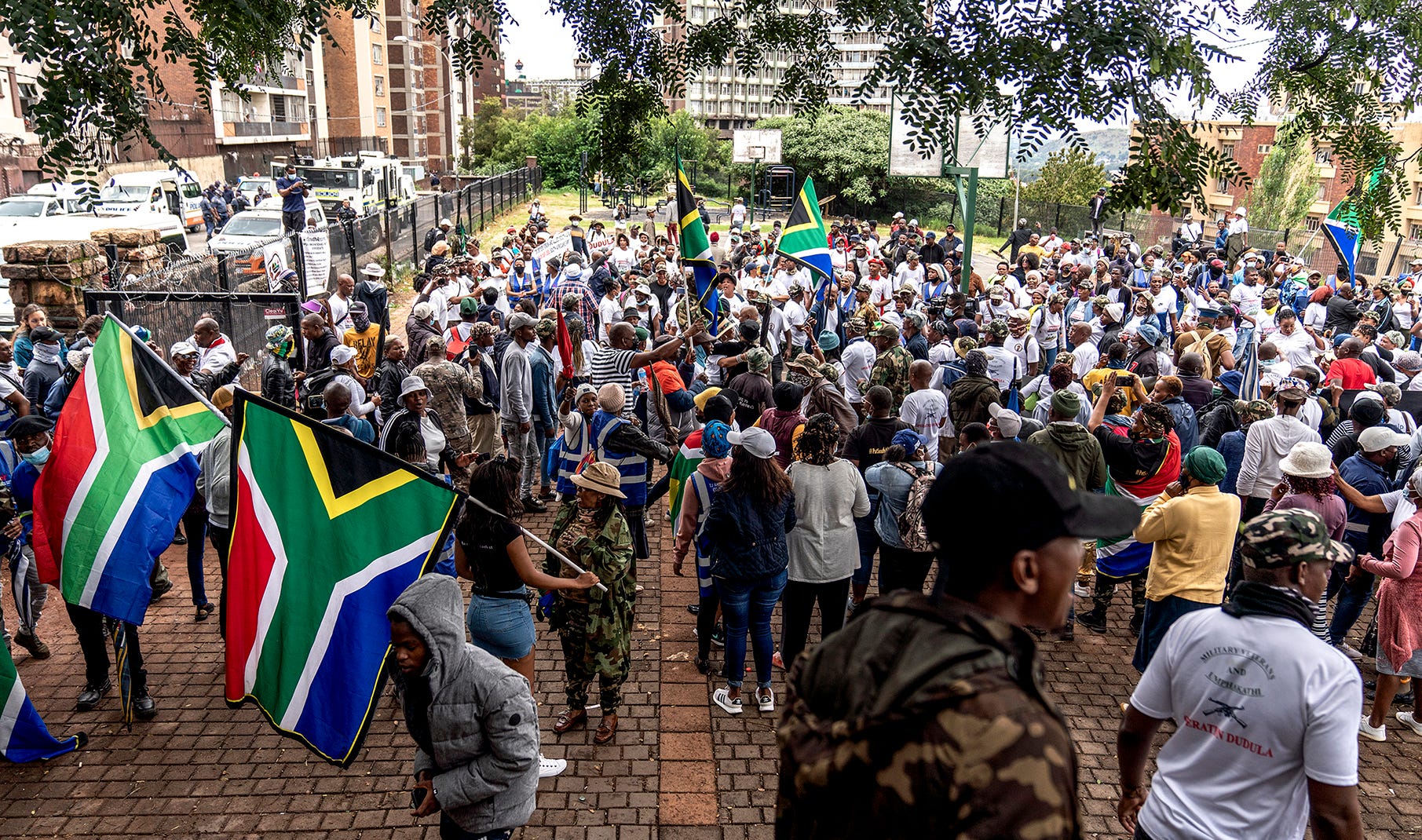
Anti-immigrant protest has returned to South Africa’s streets. IOL reports that groups such as March and March and Operation Dudula have marched in Johannesburg, calling for deportations, tighter visa controls, limits on services for undocumented migrants, and action against foreign-owned shops. In the Johannesburg CBD, tensions rose when some protesters reportedly told foreign shop owners to close their businesses. South Africa is not alone in this mood. In London, the “Unite the Kingdom” march shows how migration has become a way to speak about national decline, identity, sovereignty, and political betrayal. Al Jazeera’s piece on the far right shows how anti-immigration politics has moved from the edges of European politics into more mainstream debate.
The harder question is why these claims travel so easily. Dale McKinley’s article on migrants and work in South Africa helps here. He shows that the “job-stealing” claim hides the real labour crisis: casual work, insecure jobs, employer abuse, weak enforcement, and worsening conditions for workers across the board. Migrants become an easy target for a crisis they did not create. Mahmoudi and Denyer Willis add another layer. They show how identity now works through ID checks, profiling, suspicion, and the constant demand to prove legitimacy. The migrant does not only meet the border at entry. The border follows them into the shop, the clinic queue, the workplace, and the police stop. This is the danger of the current moment: anger about work, services, and belonging gets redirected toward people with the least protection.
“Ghana's Biggest Mobile Money Service Provider is Finally a Standalone FinTech.”
Submitted by Caroline King | Doctoral Fellow
On 31 March 2026, seven years after the regulatory framework was set and implemented, MTN’s money service subsidiary company has merged with a newly incorporated company, creating a standalone company with a new name: “MobileMoney FinTech LTD (MMFL)”. The Bank of Ghana regulation stipulates that mobile money service providers fall within the financial sector, in comparison to the telecommunication sector, often linked with the service provision, but governed by the National Communication Authority (NCA).
Although MTN’s mobile money service was operated through a subsidiary company, MMFL representatives note that this new establishment paves the way for the FinTech company to scale its mobile money service faster, allowing MTN to focus on the telco business. The separation has not created new stocks, and a full break from MTN is unlikely, as the newly created trust still allows MTN investors to retain economic interests from MMFL.
At the beginning of May, during the 3i Africa Summit, MMFL CEO Shaibu Haruna highlighted how this development could further support financial inclusion even more; and will additionally usher in a new era of mobile money cross-border transfers that remain limited across the African continent. He moreover assured service users that there would not be any disruptions during the transition to the new company, but based on comments online, this is not at the forefront of mobile money service users’ minds, instead questions around fraud prevention and secure transfers remain urgent in the eye of the consumer.
Trust in Transition is a Substack by the Trust Project, exploring the intricate interplay between trust, finance, and societal evolution within the African context. This space serves as a lens into the fascinating dynamics of trust infrastructures, financial landscapes, and their transformative impact on Africa's economic pathways.